
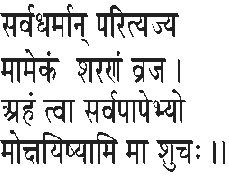
Abandon all dharmas and take refuge in Me alone. I will deliver thee from all sin and evil, do not grieve.
The Supreme Secret
Part1 | Part 2
Part 1
The essence of the teaching and the Yoga has thus been given to the disciple on the field of his work and battle and the divine Teacher now proceeds to apply it to his action, but in a way that makes it applicable to all action. Attached to a crucial example, spoken to the protagonist of Kurukshetra, the words bear a much wider significance and are a universal rule for all who are ready to ascend above the ordinary mentality and to live and act in the highest spiritual consciousness. To break out of ego and personal mind and see everything in the wideness of the self and spirit, to know God and adore him in his integral truth and in all his aspects, to surrender all oneself to the transcendent Soul of nature and existence, to possess and be possessed by the divine consciousness, to be one with the One in universality of love and delight and will and knowledge, one in him with all beings, to do works as an adoration and a sacrifice on the divine foundation of a world in which all is God and in the divine status of a liberated spirit, is the sense of the Gita's Yoga. It is a transition from the apparent to the supreme spiritual and real truth of our being, and one enters into it by putting off the many limitations of the separative consciousness and the mind's attachment to the passion and unrest and ignorance, the lesser light and knowledge, the sin and virtue, the dual law and standard of the lower nature. Therefore, says the Teacher, “devoting all thyself to me, giving up in thy conscious mind all thy actions into Me, resorting to Yoga of the will and intelligence be always one in heart and consciousness with Me. If thou art that at all times, then by my grace thou shalt pass safe through all difficult and perilous passages; but if from egoism thou hear not, thou shalt fall into perdition. Vain is this thy resolve, that in thy egoism thou thinkest, saying `I will not fight'; thy nature shall appoint thee to thy work. What from delusion thou desirest not to do, that helplessly thou shalt do bound by thy own work born of thy swabhava. The Lord is stationed in the heart of all existences, O Arjuna, and turns them all round and round mounted on a machine by his Maya. In him take refuge in every way of thy being and by his grace thou shalt come to the supreme peace and the eternal status.”
These are lines that carry in them the innermost heart of this Yoga and lead to its crowning experience and we must understand them in their innermost spirit and the whole vastness of that high summit of experience. The words express the most complete, intimate and living relation possible between God and man; they are instinct with the concentrated force of religious feeling that springs from the human being's absolute adoration, his upward surrender of his whole existence, his unreserved and perfect self-giving to the transcendent and universal Divinity from whom he comes and in whom he lives. This stress of feeling is in entire consonance with the high and enduring place that the Gita assigns to bhakti, to the love of God, to the adoration of the Highest, as the inmost spirit and motive of the supreme action and the crown and core of the supreme knowledge. The phrases used and the spiritual emotion with which they vibrate seem to give the most intense prominence possible and an utmost importance to the personal truth and presence of the Godhead. It is no abstract Absolute of the philosopher, no indifferent impersonal Presence or ineffable Silence intolerant of all relations to whom this complete surrender of all our works can be made and this closeness and intimacy of oneness with him in all the parts of our conscious existence imposed as the condition and law of our perfection or of whom this divine intervention and protection and deliverance are the promise. It is a Master of our works, a Friend and Lover of our soul, an intimate Spirit of our life, an indwelling and overdwelling Lord of all our personal and impersonal self and nature who alone can utter to us this near and moving message. And yet this is not the common relation established by the religions between man living in his sattwic or other ego-mind and some personal form and aspect of the Deity, ista-deva, constructed by that mind or offered to it to satisfy its limited ideal, aspiration or desire. That is the ordinary sense and actual character of the normal mental being's religious devotion; but here there is something wider that passes beyond the mind and its limits and its dharmas. It is something deeper than the mind that offers and something greater than the Ishta-deva that receives the surrender.
That which surrenders here is the Jiva, the essential soul, the original central and spiritual being of man, the individual Purusha. It is the Jiva delivered from the limiting and ignorant ego-sense who knows himself not as a separate personality but as an eternal portion and power and soul-becoming of the Divine, a\.m\'sa san\=atana, the Jiva released and uplifted by the passing away of ignorance and established in the light and freedom of his own true and supreme nature which is one with that of the Eternal. It is this central spiritual being in us who thus enters into a perfect and closely real relation of delight and union with the origin and continent and governing Self and Power of our existence. And he who receives our surrender is no limited Deity but the Purushottama, the one eternal Godhead, the one supreme Soul of all that is and of all Nature, the original transcendent Spirit of existence. An immutable impersonal self-existence is his first obvious spiritual self-presentation to the experience of our liberated knowledge, the first sign of his presence, the first touch and impression of his substance. A universal and transcendent infinite Person or Purusha is the mysterious hidden secret of his very being, unthinkable in form of mind, acintyarupa, but very near and present to the powers of our consciousness, emotion, will and knowledge when they are lifted out of themselves, out of their blind and petty forms into a luminous spiritual, an immeasurable supramental Ananda and power and gnosis. It is He, ineffable Absolute but also Friend and Lord and Enlightener and Lover, who is the object of this most complete devotion and approach and this most intimate inner becoming and surrender. This union, this relation is a thing lifted beyond the forms and laws of the limiting mind, too high for all these inferior dharmas; it is a truth of our self and spirit. And yet or rather therefore, because it is the truth of our self and spirit, the truth of its oneness with that Spirit from which all comes and by it and as its derivations and suggestions all exists and travails, it is not a negation but a fulfilment of all that mind and life point to and bear in them as their secret and unaccomplished significance. Thus it is not by a nirvana, an exclusion and negating extinction of all that we are here, but by a nirvana, an exclusion and negating extinction of ignorance and ego and a consequent ineffable fulfilment of our knowledge and will and heart's aspiration, an uplifted and limitless living of them in the Divine, in the Eternal, nivasisyasi mayyeva, a transfigurement and transference of all our consciousness to a greater inner status that there comes this supreme perfection and release in the spirit.
The crux of the spiritual problem, the character of this transition of which it is so difficult for the normal mind of man to get a true apprehension, turns altogether upon the capital distinction between the ignorant life of the ego in the lower nature and the large and luminous existence of the liberated Jiva in his own true spiritual nature. The renunciation of the first must be complete, the transition to the second absolute. This is the distinction on which the Gita dwells here with all possible emphasis. On the one side is this poor, trepidant, braggart egoistic condition of consciousness, ahankrta bhava, the crippling narrowness of this little helpless separative personality according to whose view-point we ordinarily think and act, feel and respond to the touches of existence. On the other are the vast spiritual reaches of immortal fullness, bliss and knowledge into which we are admitted through union with the divine Being, of whom we are then a manifestation and expression in the eternal light and no longer a disguise in the darkness of the ego-nature. It is the completeness of this union which is indicated by the Gita's satatam maccittah. The life of the ego is founded on a construction of the apparent mental, vital and physical truth of existence, on a nexus of pragmatic relations between the individual soul and Nature, on an intellectual, emotional and sensational interpretation of things used by the little limited I in us to maintain and satisfy the ideas and desires of its bounded separate personality amid the vast action of the universe. All our dharmas, all the ordinary standards by which we determine our view of things and our knowledge and our action, proceed upon this narrow and limiting basis, and to follow them even in the widest wheelings round our ego centre does not carry us out of this petty circle. It is a circle in which the soul is a contented or struggling prisoner, for ever subject to the mixed compulsions of Nature.
For Purusha veils himself in this round, veils his divine and immortal being in ignorance and is subject to the law of an insistent limiting Prakriti. That law is the compelling rule of the three gunas. It is a triple stair that stumbles upward towards the divine light but cannot reach it. At its base is the law or dharma of inertia: the tamasic man inertly obeys in a customary mechanical action the suggestions and impulses, the round of will of his material and his half-intellectualised vital and sensational nature. In the middle intervenes the kinetic law or dharma; the rajasic man, vital, dynamic, active, attempts to impose himself on his world and environment, but only increases the wounding weight and tyrant yoke of his turbulent passions, desires and egoisms, the burden of his restless self-will, the yoke of his rajasic nature. At the top presses down upon life the harmonic regulative law or dharma; the sattwic man attempts to erect and follow his limited personal standards of reasoning knowledge, enlightened utility or mechanised virtue, his religions and philosophies and ethical formulas, mental systems and constructions, fixed channels of idea and conduct which do not agree with the totality of the meaning of life and are constantly being broken in the movement of the wider universal purpose. The dharma of the sattwic man is the highest in the circle of the gunas; but that too is a limited view and a dwarfed standard. Its imperfect indications lead to a petty and relative perfection; temporarily satisfying to the enlightened personal ego, it is not founded either on the whole truth of the self or on the whole truth of Nature.
And in fact the actual life of man is not at any time one of these things alone, neither a mechanical routine execution of the first crude law of Nature, nor the struggle of a kinetic soul of action, nor a victorious emergence of conscious light and reason and good and knowledge. There is a mixture of all these dharmas out of which our will and intelligence make a more or less arbitrary construction to be realised as best it can, but never in fact realised except by compromise with other compelling things in the universal Prakriti. The sattwic ideals of our enlightened will and reason are either themselves compromises, at best progressive compromises, subject to a constant imperfection and flux of change, or if absolute in their character, they can be followed only as a counsel of perfection ignored for the most part in practice or successful only as a partial influence. And if sometimes we imagine we have completely realised them, it is because we ignore in ourselves the subconscious or half-conscious mixture of other powers and motives that are usually as much or more than our ideals the real force in our action. That self-ignorance constitutes the whole vanity of human reason and self-righteousness; it is the dark secret lining behind the spotless white outsides of human sainthood and alone makes possible the specious egoisms of knowledge and virtue. The best human knowledge is a half knowledge and the highest human virtue a thing of mixed quality and, even when most sincerely absolute in standard, sufficiently relative in practice. As a general law of living the absolute sattwic ideals cannot prevail in conduct; indispensable as a power for the betterment and raising of personal aspiration and conduct, their insistence modifies life but cannot wholly change it, and their perfect fulfilment images itself only in a dream of the future or a world of heavenly nature free from the mixed strain of our terrestrial existence. It cannot be otherwise because neither the nature of this world nor the nature of man is or can be one single piece made of the pure stuff of sattwa.
The first door of escape we see out of this limitation of our possibilities, out of this confused mixture of dharmas is in a certain high trend towards impersonality, a movement inwards towards something large and universal and calm and free and right and pure hidden now by the limiting mind of ego. The difficulty is that while we can feel a positive release into this impersonality in moments of the quiet and silence of our being, an impersonal activity is by no means so easy to realise. The pursuit of an impersonal truth or an impersonal will in our conduct is vitiated so long as we live at all in our normal mind by that which is natural and inevitable to that mind, the law of our personality, the subtle urge of our vital nature, the colour of ego. The pursuit of impersonal truth is turned by these influences into an unsuspected cloak for a system of intellectual preferences supported by our mind's limiting insistence; the pursuit of a disinterested impersonal action is converted into a greater authority and apparent high sanction for our personal will's interested selections and blind arbitrary persistences. On the other hand an absolute impersonality would seem to impose an equally absolute quietism, and this would mean that all action is bound to the machinery of the ego and the three gunas and to recede from life and its works the only way out of the circle. This impersonal silence however is not the last word of wisdom in the matter, because it is not the only way and crown or not all the way and the last crown of self-realisation open to our endeavour. There is a mightier fuller more positive spiritual experience in which the circle of our egoistic personality and the round of the mind's limitations vanish in the unwalled infinity of a greatest self and spirit and yet life and its works not only remain still acceptable and possible but reach up and out to their widest spiritual completeness and assume a grand ascending significance.
There have been different gradations in this movement to bridge the gulf between an absolute impersonality and the dynamic possibilities of our nature. The thought and practice of the Mahayana approached this difficult reconciliation through the experience of a deep desirelessness and a large dissolving freedom from mental and vital attachment and sanskaras and on the positive side a universal altruism, a fathomless compassion for the world and its creatures which became as it were the flood and outpouring of the high Nirvanic state on life and action. That reconciliation was equally the sense of yet another spiritual experience, more conscious of a world significance, more profound, kindling, richly comprehensive on the side of action, a step nearer to the thought of the Gita: this experience we find or can at least read behind the utterances of the Taoist thinkers. There there seems to be an impersonal ineffable Eternal who is spirit and at the same time the one life of the universe: it supports and flows impartially in all things, samam brahma; it is a One that is nothing, Asat, because other than all that we perceive and yet the totality of all these existences. The fluid personality that forms like foam on this Infinite, the mobile ego with its attachments and repulsions, its likings and dislikings, its fixed mental distinctions, is an effective image that veils and deforms to us the one reality, Tao, the supreme All and Nothing. That can be touched only by losing personality and its little structural forms in the unseizable universal and eternal Presence and, this once achieved, we live in that a real life and have another greater consciousness which makes us penetrate all things, ourselves penetrable to all eternal influences. Here, as in the Gita, the highest way would seem to be a complete openness and self-surrender to the Eternal. “Your body is not your own,” says the Taoist thinker, “it is the delegated image of God: your life is not your own, it is the delegated harmony of God: your individuality is not your own, it is the delegated adaptability of God.” And here too a vast perfection and liberated action are the dynamic result of the soul's surrender. The works of ego personality are a separative running counter to the bias of universal nature. This false movement must be replaced by a wise and still passivity in the hands of the universal and eternal Power, a passivity that makes us adaptable to the infinite action, in harmony with its truth, plastic to the shaping breath of the Spirit. The man who has this harmony may be motionless within and absorbed in silence, but his Self will appear free from disguises, the divine Influence will be at work in him and while he abides in tranquillity and an inward inaction, nai\,skarmya, yet he will act with an irresistible power and myriads of things and beings will move and gather under his influence. The impersonal force of the Self takes up his works, movements no longer deformed by ego, and sovereignly acts through him for the keeping together and control of the world and its peoples, loka-sangraharthaya.
There is little difference between these experiences and the first impersonal activity inculcated by the Gita. The Gita also demands of us renunciation of desire, attachment and ego, transcendence of the lower nature and the breaking up of our personality and its little formations. The Gita also demands of us to live in the Self and Spirit, to see the Self and Spirit in all and all in the Self and Spirit and all as the Self and Spirit. It demands of us like the Taoist thinker to renounce our natural personality and its works into the Self, the Spirit, the Eternal, the Brahman, atmani sannyasya, brahmani. And there is this coincidence because that is always man's highest and freest possible experience of a quietistic inner largeness and silence reconciled with an outer dynamic active living, the two coexistent or fused together in the impersonal infinite reality and illimitable action of the one immortal Power and sole eternal Existence. But the Gita adds a phrase of immense import that alters everything, atmani atho mayi. The demand is to see all things in the self and then in “Me” the Ishwara, to renounce all action into the Self, Spirit, Brahman and thence into the supreme Person, the Purushottama. There is here a still greater and profounder complex of spiritual experience, a larger transmutation of the significance of human life, a more mystic and heart-felt sweep of the return of the stream to the ocean, the restoration of personal works and the cosmic action to the Eternal Worker. The stress on pure impersonality has this difficulty and incompleteness for us that it reduces the inner person, the spiritual individual, that persistent miracle of our inmost being, to a temporary, illusive and mutable formation in the Infinite. The Infinite alone exists and except in a passing play has no true regard on the soul of the living creature. There can be no real and permanent relation between the soul in man and the Eternal, if that soul is even as the always renewable body no more than a transient phenomenon in the Infinite.
It is true that the ego and its limited personality are even such a temporary and mutable formation of Nature and therefore it must be broken and we must feel ourselves one with all and infinite. But the ego is not the real person; when it has been dissolved there still remains the spiritual individual, there is still the eternal Jiva. The ego limitation disappears and the soul lives in a profound unity with the One and feels its universal unity with all things. And yet it is still our own soul that enjoys this expanse and oneness. The universal action, even when it is felt as the action of one and the same energy in all, even when it is experienced as the initiation and movement of the Ishwara, still takes different forms in different souls of men, amsah sanatanah, and a different turn in their nature. The light of spiritual knowledge, the manifold universal Shakti, the eternal delight of being stream into us and around us, concentrate in the soul and flow out on the surrounding world from each as from a centre of living spiritual consciousness whose circumference is lost in the infinite. More, the spiritual individual remains as a little universe of divine existence at once independent and inseparable from the whole infinite universe of the divine self-manifestation of which we see a petty portion around us. A portion of the Transcendent, creative, he creates his own world around him even while he retains this cosmic consciousness in which are all others. If it be objected that this is an illusion which must disappear when he retreats into the transcendent Absolute, there is after all no very certain certainty in that matter. For it is still the soul in man that is the enjoyer of this release, as it was the living spiritual centre of the divine action and manifestation; there is something more than the mere self-breaking of an illusory shell of individuality in the Infinite. This mystery of our existence signifies that what we are is not only a temporary name and form of the One, but as we may say, a soul and spirit of the Divine Oneness. Our spiritual individuality of which the ego is only a misleading shadow and projection in the ignorance has or is a truth that persists beyond the ignorance; there is something of us that dwells for ever in the supreme nature of the Purushottama, nivasisyasi mayi. This is the profound comprehensiveness of the teaching of the Gita that while it recognises the truth of the universalised impersonality into which we enter by the extinction of ego, brahma-nirvana, —for indeed without it there can be no liberation or at least no absolute release,—it recognises too the persistent spiritual truth of our personality as a factor of the highest experience. Not this natural but that divine and central being in us is the eternal Jiva. It is the Ishwara, Vasudeva who is all things, that takes up our mind and life and body for the enjoyment of the lower Prakriti; it is the supreme Prakriti, the original spiritual nature of the supreme Purusha that holds together the universe and appears in it as the Jiva. This Jiva then is a portion of the Purushottama's original divine spiritual being, a living power of the living Eternal. He is not merely a temporary form of lower Nature, but an eternal portion of the Highest in his supreme Prakriti, an eternal conscious ray of the divine existence and as everlasting as that supernal Prakriti. One side of the highest perfection and status of our liberated consciousness must then be to assume the true place of the Jiva in a supreme spiritual Nature, there to dwell in the glory of the supreme Purusha and there to have the joy of the eternal spiritual oneness.
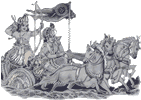
Sri Aurobindo
 About Us| ©1999 - 2009 searchforlight.org
All extracts and quotations from the written works of Sri Aurobindo and the Mother and the Photographs of
the Mother and Sri Aurobindo are copyright Sri Aurobindo Ashram Trust, Pondicherry -605002 India.